Case Study: Low-Frequency Ultrasound ML
Real-time classification for grinding wheel state and process quality.
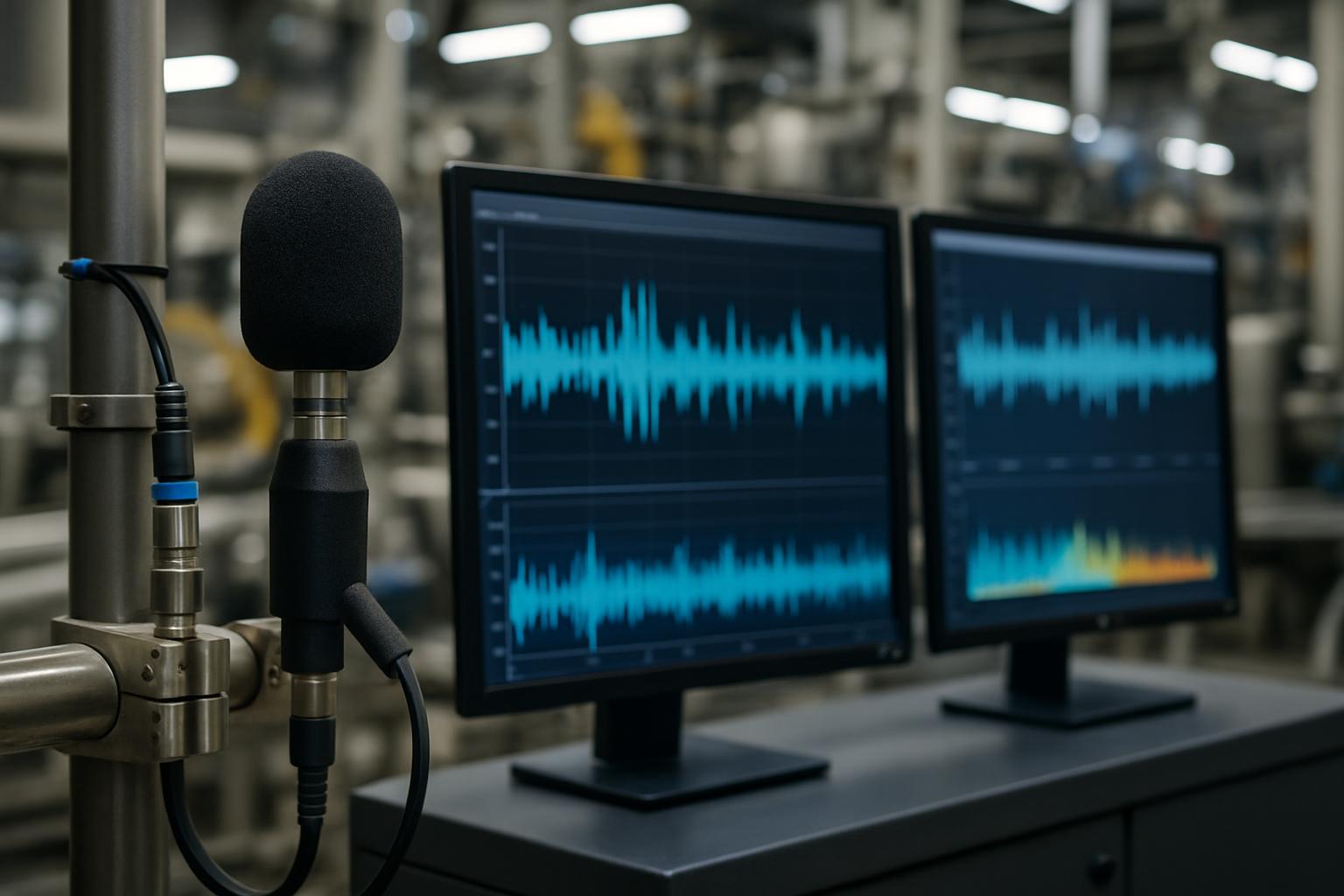
Project Snapshot
- Role: ML Solution Lead
- Domain: Industrial process monitoring
- Stack: Python, signal processing, supervised ML, real-time decision logic
- Timeline: Research-to-production deployment
Related quality programs
>60% Defect-Crisis Reduction
Analytics-led quality programs using this ML-first operating style reduced major defect crises by more than 60%.
Targeted optimization
>10% Yield Improvement
Yield gains exceeding 10% where real-time classification informed intervention timing.
Model validation
Exceeded Human Baseline
Classifier outperformed human measurement consistency — but that's not ground truth, just the available baseline.
Production deployment
Real-Time Edge Inference
Sub-second classification on edge devices for live grinding wheel state monitoring.
Technical Architecture
graph TD
    subgraph Data_Collection
        A[Ultrasound Sensor] --> B[Signal Acquisition]
        B --> C[Feature Extraction]
    end

    subgraph Preprocessing
        C --> D[Noise Filtering]
        D --> E[Time-Frequency Transform]
        E --> F[Feature Engineering]
    end

    subgraph Model
        F --> G[Trained Classifier]
        G --> H[Wheel State Prediction]
    end

    subgraph Deployment
        H --> I[Edge Device]
        I --> J[Real-Time Alert]
        I --> K[Process Control]
    end

    subgraph Feedback
        J --> L[Operator Action]
        K --> M[Quality Outcome]
        M --> N[Model Retraining Data]
        N --> G
    end
Architecture: Ultrasound sensors capture acoustic emissions from grinding wheels. Signal processing extracts time-frequency features. A trained classifier predicts wheel state (sharp, dull, loaded) in real-time. Deployed to edge devices for sub-second inference. Feedback loop enables continuous improvement.
Decision Tradeoffs
| Option Considered | Pros | Cons | Decision |
|---|---|---|---|
| Supervised ML (Random Forest) | Interpretable, handles engineered features well, fast inference | Requires labeled data, feature engineering effort | Selected — best balance of interpretability and performance for production |
| Deep Learning (CNN) | Automatic feature learning, potentially higher accuracy | Black-box, requires GPU, harder to debug in production | Rejected — interpretability was critical for operator trust |
| Rule-Based Thresholding | Simple, no training data needed | Can't capture complex patterns, high false positive rate | Rejected — prior attempts showed insufficient accuracy |
Problem
Large-format slag grinding wheel quality affects product quality and process efficiency. Operators lacked real-time visibility into wheel state, leading to delayed interventions and inconsistent outcomes. The core challenge: human measurement isn't "correct" — it's just the available baseline.
Approach
I designed a supervised ML pipeline using low-frequency ultrasound (LFUS) acoustic emissions from grinding wheels. Human testing provided labeled training data. The classifier exceeded human measurement consistency — but that's not ground truth, just the starting point.
The real work: iterating on the metric over time as patterns emerge, building operator trust, and evolving from "matches human" to "beyond human" as understanding deepens.
Outcome
Real-time edge inference enabled proactive wheel change decisions. Related quality programs saw >60% reduction in defect crises and >10% yield improvement where classification informed intervention timing.
- Model validation: Outperformed human baseline — but ground truth is the long game
- Deployment: Edge devices with sub-second inference for live monitoring
- Business outcomes: >60% defect-crisis reduction, >10% yield improvement
Leadership Contribution
- Architecture: Designed the LFUS signal processing pipeline and selected Random Forest over deep learning for interpretability in production.
- Validation: Navigated the ground truth problem — model exceeded human consistency, but real accuracy emerges through iterative refinement with operators.
- Team: Coordinated with plant engineers for sensor installation, data collection protocols, and operator training.
- Outcomes: Real-time edge inference enabled proactive wheel changes, contributing to >60% defect-crisis reduction in related programs.