Problem
LLMs and agent frameworks give you raw power, but without a governed operating layer, you accumulate noise: scattered prompts, unreproducible sessions, invisible decisions, and no way to inspect why the system did what it did.
Systems engineering · Cognitive infrastructure · Visual manual
A visual engineering manual for designing, operating, and evolving personal cognitive infrastructure with OpenClaw. Covers the full stack: memory systems, model routing, autonomous agents, cron-based automation, and the operator interface between human intention and AI execution.
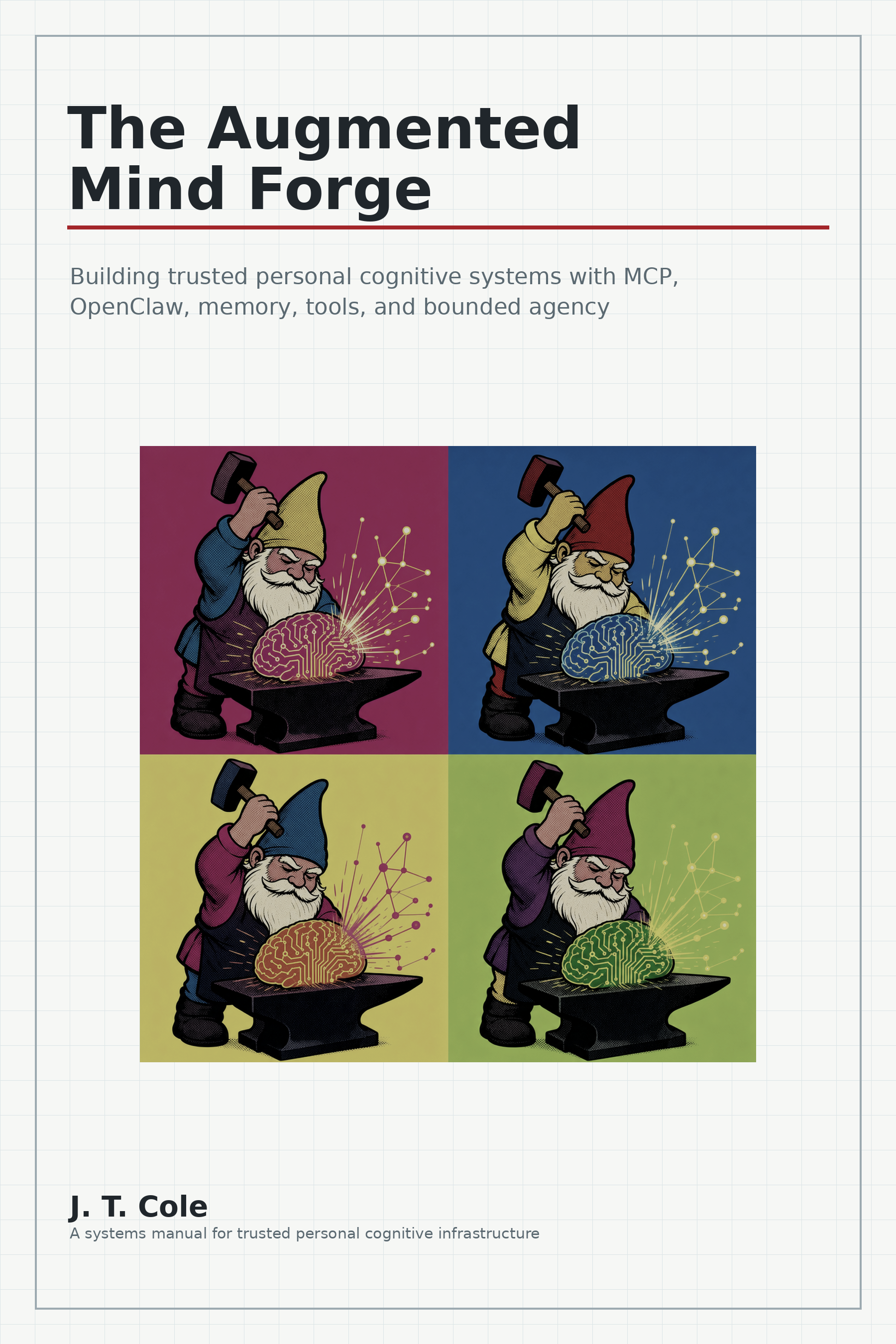
Why cognitive infrastructure matters
LLMs and agent frameworks give you raw power, but without a governed operating layer, you accumulate noise: scattered prompts, unreproducible sessions, invisible decisions, and no way to inspect why the system did what it did.
The Augmented Mind Forge treats your PKM vault as the central nervous system. Memory is structured in zettels and MoCs. Decisions route through cognitive assessment. Agents operate within sandboxed workspaces. Every action produces an audit trail.
A personal cognitive infrastructure that scales: you add models, agents, and automation without losing visibility. The system stays inspectable, debuggable, and improvable because the architecture is explicit, not emergent.
Four-system fusion
Long-term semantic memory with vector similarity search. Stores preferences, decisions, facts, and entities. Recalled on-demand during sessions for context continuity.
Cognitive assessment determines task complexity (System 1 vs System 2). Principle activation via Q-K semantic matching selects relevant design principles. FLARE lookahead planning avoids autoregressive greedy traps.
Feedback loop extracts, refines, and retires design principles from session outcomes. Principles evolve through use — high-activation patterns are reinforced, stale principles are deprecated.
Continuous monitoring across all subsystems: principle activation rates, memory hit ratios, routing decision quality, and learning velocity. Exported as JSON metrics displayed on a public dashboard.
The missing layer
The book documents the full set of operating rituals: daily note generation, session logging, morning briefs, weekly reviews, sprint planning, and retrospective closure. Each ritual has a designated owner (human or automation), frequency, and output format.
External actions (email sends, social posts, code deploys) require explicit approval. Private vault data never leaks to public surfaces. Agent sandboxes prevent cross-contamination. The system defaults to read-only; writes are opt-in and audited.
The architecture supports adding new models, agents, skills, and automation without rewriting the governance layer. New subsystems plug into the existing memory, routing, and diagnostics infrastructure. The book is a map — the system is the territory.
Covered systems
Zettelkasten organization, Maps of Content, daily notes, project notes, sprint notes, status boards, and the private/public visibility split.
Agent-builder, site-designer, site-developer, site-operator, stat-modeler, vault-maintainer, and the Codex autonomous coding agent.
GLM-5.1 for routine work, DeepSeek v4 for creativity/subagents, GPT-5.5 as paid fallback. Cognitive assessor routes tasks to appropriate model tiers.
10 cron jobs managing daily generation, email checks, metrics export, workspace sync, weekly review prep, and multi-channel publishing workflows.
Read it now
The first edition in a technical publisher format, built from the repository pipeline with professional typesetting and full figure set.
The complete book source, cover assets, figure generation scripts, and build tooling.
Visit RepositoryBrowse the visual design assets, system diagrams, and cover variations.
Browse AssetsThe companion executable book for MCP agent development with DSPy.
View BookPositioning
The Augmented Mind Forge documents a living system. Rituals, automation, and safety boundaries compound over time. The book captures the architecture; the vault proves it works.